

Maison Margiela / Folders
Maison Margiela / Folders:
Opening the Archive

Why Margiela Is Revealing the Process Now

Maison Margiela has never been a house that communicates in conventional ways. Since its founding by Martin Margiela, the brand has built its identity on anonymity, deconstruction, and the idea that what is hidden can often be more powerful than what is seen.
With Maison Margiela / folders, the house shifts that philosophy outward — opening up its internal world for the public to experience. More than an exhibition series, folders functions as a living archive: a rare glimpse into the research, references, and working processes that usually remain behind atelier doors.
At a moment when fashion moves faster than ever, this project feels deliberate. It slows things down. It invites the audience not just to consume the final garment, but to understand the thinking, experimentation, and cultural layering that define Margiela’s work. In doing so, the house reinforces its long-standing influence — not through spectacle, but through depth.
A Living Archive Across Cities

Taking place across multiple cities in China this April, Maison Margiela / folders unfolds as a series of exhibitions and experiences, each focusing on a core element of the house’s identity. Sign-ups are available through a dedicated WeChat Mini Program, while additional imagery and internal materials are shared through the Maison Margiela / folders Dropbox — extending the experience beyond physical space into a digital archive.
Each location becomes a chapter, revealing a different layer of the brand’s visual language.
ARTISANAL: The Language of Creation

Shanghai, April 2–6
The Artisanal exhibition brings together couture pieces spanning from 1989 to the present — shown together for the first time. These works represent the most experimental side of Maison Margiela: garments constructed through transformation, reconstruction, and the reimagining of existing materials.
Here, the atelier becomes visible. Techniques once hidden are placed at the center, reframing fashion not as product, but as process.


ANONYMITY: The Power of Disappearance

Beijing, April 7–12
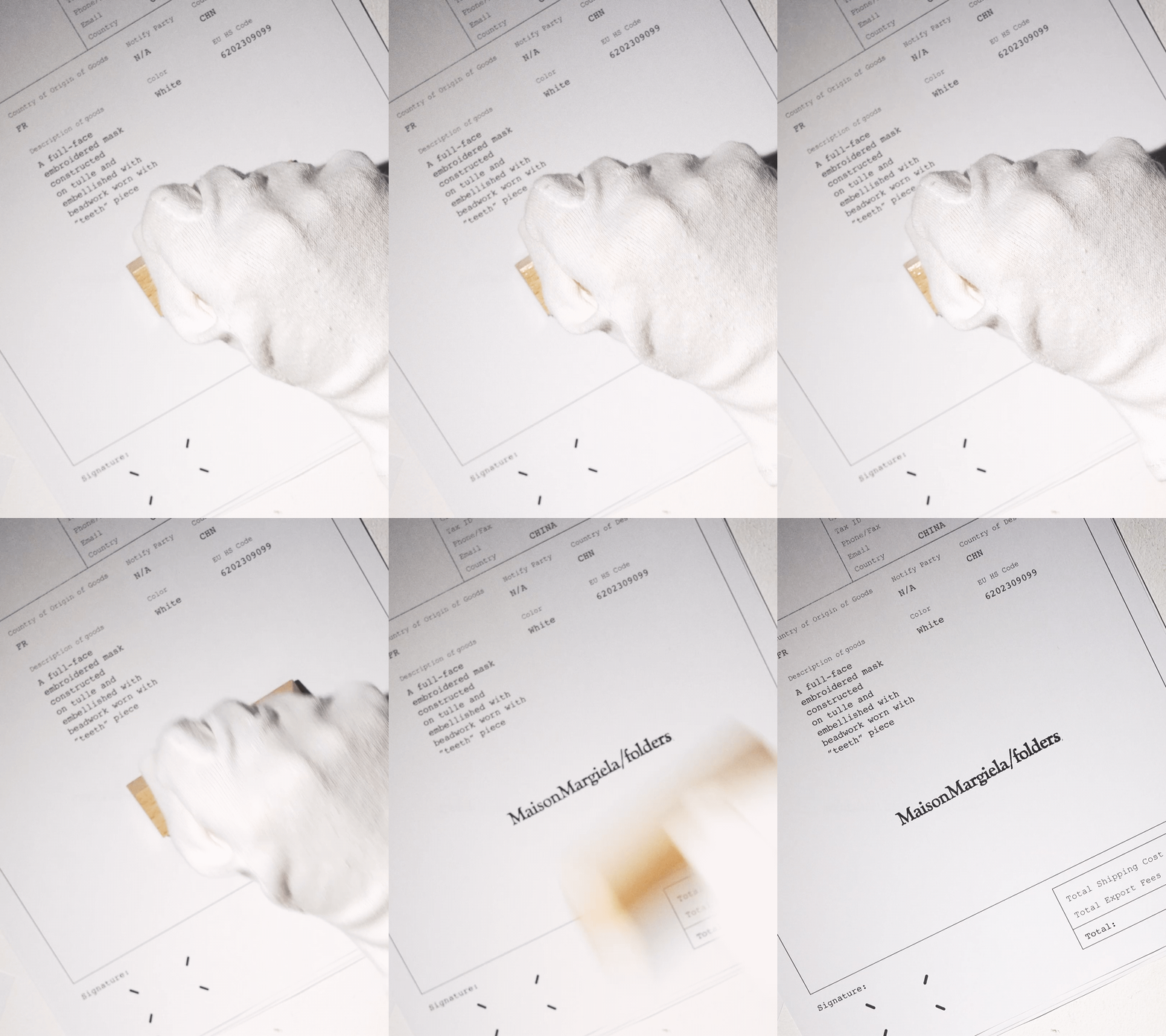
In Beijing, the Anonymity exhibition gathers 48 masks, both new and archival, tracing a defining concept of the house since its earliest collections. Anonymity, for Margiela, is not about absence — it is about shifting focus from the individual to the work itself.

Across decades, the mask has become a symbol: removing identity in order to amplify expression. This exhibition maps how that idea continues to shape the brand’s visual language today.
TABI: A Community of Expression

Chengdu, April 9–13

Few designs carry as much cultural weight as the Tabi. In Chengdu, the Tabi Collectors exhibition brings together the personal archives of nine collectors from around the world, highlighting how a single silhouette has evolved into a global symbol of individuality.

What began as a reinterpretation of a traditional Japanese split-toe sock has become something far beyond footwear — a marker of identity, taste, and belonging within a shared cultural language.
BIANCHETTO: The Act of Transformation

Shenzhen, April 11–12
In Shenzhen, the experience becomes participatory. The Bianchetto Atelier invites visitors to bring their own garments and transform them using the house’s signature white-overpainting technique, guided by the atelier team.

It is a rare moment where the boundary between creator and wearer dissolves — where Margiela’s philosophy becomes something lived, not just observed.

Beyond Exhibition: Influence and Continuity

Maison Margiela / folders is not simply a retrospective. It is a statement about how fashion can exist beyond seasonal cycles — as archive, as dialogue, as evolving practice.
By opening its internal processes, the house reinforces what has always set it apart: a commitment to ideas over image, and to experimentation over convention. In doing so, it continues to influence not only designers, but the way audiences engage with fashion itself.
Read more
An exploration of Ann Demeulemeester’s poetic vision — from her roots in Antwerp and the rise of the Antwerp Six to a legacy defined by dark romanticism, precise tailoring, and quiet rebellion. Dis...
Discover 5avant-garde fashion designers redefining modern style, from emerging voices to established names shaping the future of fashion.