What Is Y-3? The Story Behind adidas' Influential Fashion Collaboration
What Is Y-3? The Story Behind adidas' Influential Fashion Collaboration

Y-3 feels completely normal in fashion today.
A designer working with a major sportswear company? We’ve seen it countless times. Luxury brands reinterpret sneakers. Athletic companies invite fashion designers into their archives. Performance technology appears on runways. But when Yohji Yamamoto and adidas began working together more than two decades ago, that relationship was far less established.
Y-3 became one of the earliest examples of a sportswear company and an avant-garde designer building a genuine fashion label together—not just releasing a one-off sneaker or limited capsule.
The partnership combined adidas’ technical knowledge and athletic heritage with Yamamoto’s approach to black clothing, draping, oversized proportion and unconventional tailoring. The result helped establish what adidas now describes as the category of “fashion sportswear.”

So, what is Y-3, what does the name actually mean, and why has the collaboration lasted for more than 20 years?
What Does Y-3 Mean?

The answer is surprisingly simple. The Y” in Y-3 represents Yohji Yamamoto, while the “3” refers to adidas’ Three Stripes.
The name essentially places the two sides of the partnership next to one another: Yamamoto’s fashion language and adidas’ sporting identity. The concept was visible from Y-3’s earliest collections, where adidas stripes appeared across clothing shaped by Yamamoto’s proportions and tailoring.
That balance is still what defines the brand. Y-3 isn’t Yohji Yamamoto clothing with an adidas logo added at the end. It also isn’t standard adidas sportswear sold at a higher price.
The most successful pieces feel like something neither side would have created independently.
When Yohji Yamamoto Met the Three Stripes

The relationship began before Y-3 officially existed.
Yamamoto had already become one of the most important Japanese designers working in Paris, known for an approach built around black, asymmetry, unconventional tailoring and volume. By the beginning of the 2000s, though, he was becoming interested in the way younger people were dressing on the street.
Sportswear was part of that conversation.
Yamamoto began working with adidas around 2001, initially bringing the Three Stripes into his own collections. Contemporary coverage from 2001 was already describing the partnership as a meeting between Yamamoto’s tailoring and adidas sports references.
The idea grew quickly. In October 2002, adidas and Yamamoto presented the inaugural Y-3 collection in Paris for Spring 2003. The collection treated sportswear as fashion rather than simply athletic equipment: fluid trousers, relaxed jackets, mesh, sneakers and Three Stripe details were integrated into complete runway looks.
More Than a Designer Collaboration

This is the part that made Y-3 unusual. A collaboration usually ends. Y-3 didn’t.
Instead of inviting Yamamoto to redesign one sneaker and then move on, adidas gave the project space to develop into its own label, spanning footwear, clothing, accessories, runway presentations and an evolving design vocabulary.
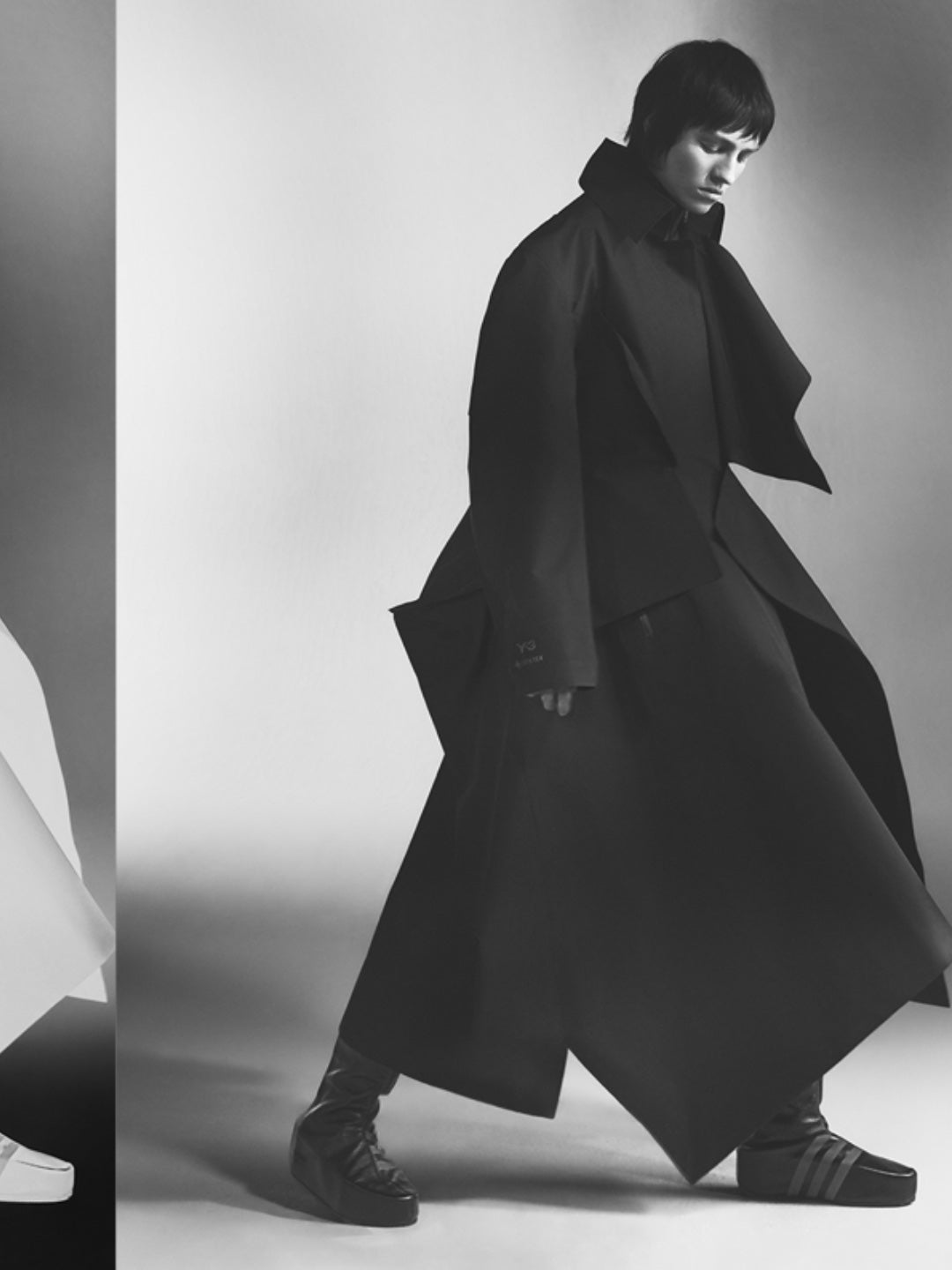
Yamamoto brought his signature approach to oversized proportions, relaxed tailoring, draped fabrics, predominantly black palettes, asymmetry and movement. Adidas contributed its expertise in sportswear engineering, footwear development, performance fabrics, athletic archives and technical manufacturing, alongside its instantly recognizable Three Stripes.
The combination created the tension that still makes Y-3 interesting. Track pants take on the volume of designer trousers, technical jackets become almost sculptural, and the Three Stripes are integrated into garments in ways that move beyond conventional sportswear.

Today, Y-3 continues to bring together adidas’ performance-driven innovation with Yamamoto’s distinctive approach to tailoring and elegance.
From Sportswear Experiment to Fashion Blueprint

It’s easy to underestimate Y-3’s influence because the formula now seems so familiar.
Today, designer-sportswear collaborations appear constantly. But Y-3 developed before the relationship between luxury fashion and sneakers became a major commercial category.
That matters.
Rather than creating hype through short availability, adidas and Yamamoto showed that a collaboration could function as an ongoing creative partnership. Twenty years later, adidas was still revisiting archival Y-3 designs through its “20 Years: Re-Coded” project.
The brand also helped change what customers expected from athletic clothing. Sports references no longer needed to look purely functional. Technical fabric could be draped. Running technology could appear beneath avant-garde footwear. A tracksuit could belong on a runway without pretending to be a traditional suit.
That overlap now feels normal across contemporary fashion.
Y-3 helped make it normal.
What Makes adidas Y-3 Unique?

The easiest way to understand Y-3 is to look at how the brand handles familiar adidas ideas.
Instead of abandoning sportswear, Yamamoto exaggerates or redirects it.
Black, White and the Three Stripes

Yamamoto’s relationship with black naturally became one of Y-3’s strongest visual codes.
Black often dominates the clothing, allowing construction and proportion to do most of the work. White Three Stripe graphics create contrast, while occasional seasonal colours interrupt the palette.
The result is unmistakably connected to adidas without looking like ordinary teamwear.
Volume and Movement

Y-3 frequently uses wide trousers, extended shirts, oversized outerwear and layered shapes.
That volume isn’t purely visual. Sportswear is fundamentally concerned with movement, and Yamamoto’s clothing has always been interested in how fabric moves around a person. Y-3 gives those two ideas a natural meeting point.
Performance Technology

The partnership also gives Yamamoto access to adidas technology.
Over the years, Y-3 has incorporated systems such as BOOST, Primeknit and technical running platforms into footwear and clothing. Adidas has even developed dedicated Y-3 performance running collections based directly on existing running products reworked through Yamamoto’s design language.
That creates an unusual proposition: fashion-led product that may contain real performance technology rather than merely borrowing the appearance of sportswear.
Is Y-3 a Luxury Brand?

Yes, Y-3 is generally positioned as a designer or luxury sportswear brand, although it sits between several conventional categories. It’s closely connected to adidas, one of the world’s largest athletic companies, but Y-3 operates differently from standard adidas product. Its positioning comes from Yohji Yamamoto’s creative direction, designer-level pricing, fashion-focused distribution and long runway history, alongside specialized materials, experimental silhouettes and limited seasonal product.
So calling Y-3 simply “adidas” misses part of the picture. Calling it traditional luxury doesn’t describe it perfectly either. “Designer sportswear” may be the most accurate description because the partnership deliberately combines both worlds.
That ambiguity is one of the reasons the label has remained interesting.
The Pieces That Defined Y-3

Y-3 has produced hundreds of footwear and apparel designs, but a few categories explain the partnership particularly well.
Y-3 Qasa

The Qasa High is probably the closest Y-3 has come to creating its own universally recognized sneaker icon. Introduced in 2013, the shoe combines a neoprene sock-like upper with elastic straps and an exaggerated sole based on adidas’ 1990s Tubular running technology.
The result doesn’t look like a normal running shoe or conventional luxury sneaker.
That’s exactly why it works.
Reworked adidas Classics

Another major part of Y-3 is the reinterpretation of familiar adidas shapes. Gazelles, court shoes, football-inspired footwear and running silhouettes can all be filtered through Y-3’s materials and colour palette.
This is where the collaboration can be most approachable.
A customer who doesn’t want one of Y-3’s most experimental silhouettes can still get the partnership’s design language through a recognizable adidas shape.
Feuille’s current Y-3 footwear collection includes styles such as the Gazelle, Field, Tokyo and performance-influenced footwear.
Technical Outerwear

Outerwear gives both partners room to work.
Adidas contributes the technical logic, while Yamamoto changes scale and silhouette. Parkas become oversized. Utility jackets are elongated. Functional closures and pockets sit within shapes that feel closer to avant-garde fashion than conventional performance apparel.
Wide Trousers and Layered Clothing

Y-3 trousers often demonstrate Yamamoto’s influence most clearly.
Wide legs, dropped shapes and fluid fabrics move away from the narrow technical fit normally associated with sportswear. Pair them with a long top or technical jacket and the relationship becomes obvious: the clothing is athletic in reference but fashion-led in proportion.
How Long Has Y-3 Been Around?

Y-3 has existed for more than two decades.
Adidas traces the brand to 2002, while its debut Spring/Summer 2003 runway collection was presented in Paris in October 2002.
That longevity is important. Plenty of designer collaborations generate attention for one season.
Very few become brands in their own right. Y-3 has survived shifting sneaker trends, the rise and decline of hype culture, changing silhouettes and entirely different generations of customers.
Its central idea has remained surprisingly consistent throughout: take the innovation of adidas and express it through Yohji Yamamoto’s fashion language.
More than 20 years later, that idea still gives both sides room to experiment.
Frequently Asked Questions

What does Y-3 stand for?
The “Y” represents Yohji Yamamoto and the “3” represents adidas’ Three Stripes. The name symbolizes the two sides of the long-running partnership.
What is the Y-3 brand?
Y-3 is a collaborative fashion label created by adidas and Japanese designer Yohji Yamamoto. It combines adidas sportswear technology and heritage with Yamamoto’s avant-garde approach to fashion.
Is Y-3 owned by adidas?
Y-3 is produced as a long-running partnership between adidas and Yohji Yamamoto rather than operating as Yamamoto’s independent namesake label.
When did Y-3 start?
The partnership developed in the early 2000s. adidas identifies Y-3 as founded in 2002, and its first full Spring/Summer 2003 runway collection was shown in Paris in October 2002.
What is Y-3 most famous for?
Y-3 is especially known for avant-garde sportswear, black-and-white clothing, oversized silhouettes and footwear such as the Qasa. It also regularly reinterprets classic adidas designs through Yohji Yamamoto’s aesthetic.
Discover Y-3 at Feuille

More than 20 years after its debut, Y-3 still occupies a space few labels can reproduce. It has the technical resources and sporting archive of adidas without losing Yohji Yamamoto’s unmistakable perspective on proportion, movement and clothing.
At Feuille, we curate Y-3 clothing, footwear and accessories, alongside a dedicated selection of Y-3 shoes ranging from reworked adidas classics to more technical silhouettes.
Explore Y-3 online at Feuille or visit our Vancouver boutique to see how one of fashion’s longest-running collaborations continues to evolve.